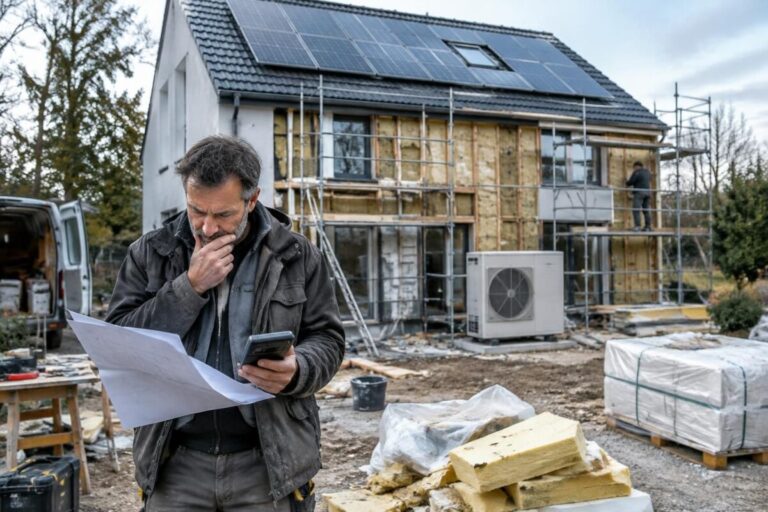

Green transition: this green project quickly becomes incoherent
Hello, this is Quentin.
A so-called “green” project becomes incoherent when its ecological ambitions are not translated into verifiable decisions.
Reducing waste is not enough if materials travel hundreds of kilometers or if energy consumption remains unmonitored. In 2026, the Nice Côte d’Azur Metropolis’ approach provides a concrete framework: it has been applied to its works contracts since 2022 and evolves thanks to field feedback. The challenge is to link each promise to objectives, to those responsible, and to an assessment.
Actions to take now to avoid ecological incoherence on a construction site
- Set measurable objectives for waste, water, electricity and fuels.
- Plan for reuse from the design phase, before ordering new materials.
- Identify local supply chains and verify the final destination of waste.
- Appoint a point of contact per company and a coordinator responsible for overall monitoring.
- Compare the results with the forecasts during the works, then in the final assessment.
An ill-planned project can weigh down costs and reduce expected gains: these paths on the order of works and the budget and on the starting point of a coherent transition help clarify priorities.
When a green construction site contradicts its own objectives
The trap is to confuse a good intention with an environmental result. A waste sorting skip does not, by itself, guarantee that materials will be valued: one must follow their path to their final destination.
Imagine a company renovating a building and installing high-performance equipment, but disposes of reusable materials into a distant processing stream. The site can then display a positive action while increasing its carbon footprint and missing an opportunity to support local employment.
This gap fuels suspicion of greenwashing. To avoid it, each commitment must be associated with evidence: quantities reused, volumes of waste traced, consumptions measured, and measures taken to protect biodiversity.
The five points that make the approach coherent
The Green Construction Site Charter of the Nice Côte d’Azur Metropolis organizes expectations around five themes. They cover the concrete impacts of the site, rather than just the communications around sustainable development.
| Themes | What to verify | Concrete example |
|---|---|---|
| Organization | Responsibilities, instructions and monitoring | A designated point of contact in each company |
| Resources and waste | Reuse, sorting and traceability | Materials set aside for a second life |
| Nuisances and image | Noise, dust, traffic and cleanliness | Working hours adjusted to local residents |
| Consumptions | Water, electricity, heating and fuels | Regular readings rather than a final estimate |
| Environmental prevention | Pollution risks and protection of environments | Storage zones away from sensitive spaces |
These criteria reinforce each other. For example, sorting becomes more effective when storage areas are planned upstream and the teams know whom to hand the recovered materials to.
A green transition to prepare before the construction site opens
The approach must begin at the definition of needs. It is at this stage that the project owner can embed circular economy requirements into the procurement documents, rather than asking the companies to correct course after the works have started.
The metropolitan charter then relies on two relays: the Green Construction Site Coordinator, who represents the project owner, and the company referents. Checks take place during site meetings, then an assessment compares the management of resources and waste to the initial forecasts.
The presentation of the Green Construction Site approach of the Metropolis details this framework. To deepen the levers for reducing nuisances and the impact of works, the SOCOTEC guide on low-impact construction sites provides a practical supplement.
Three steps to turn commitments into results
- Before the consultation : identify reusable resources, site constraints, and local supply chains. Record the objectives in the documents provided to the companies.
- During the works : designate the referents, track consumptions and verify waste traceability during meetings. Adjust practices as soon as any deviation appears.
- At handover : compare the results with the forecasts and note the gaps. This feedback is used to improve future construction and to advance the teams’ competencies.
The mapping of local circular economy actors can help find reuse and recycling solutions suited to the territory. The better the supply chains are known, the less likely materials are to end up without valorization.
Measuring ecological impact rather than multiplying promises
A coherent construction site is not necessarily the one that shows the most actions. It is the one that chooses measures suited to the site, tracks their effects and corrects environmental contradictions when they appear.
The same logic applies to equipment advertised as durable: installing renewable energy does not automatically compensate for material losses, excessive consumption, or harm to natural habitats. Climate policies gain credibility when results are documented, understandable, and compared to the initial objectives.
At the scale of a project, transparency turns the green transition into a concrete approach: fewer primary resources consumed, better-traced waste, and a better consideration of biodiversity.
When should you integrate the charter of a green construction site?
From the definition of needs, before the consultation of the companies. This allows registering the objectives of reuse, waste management and nuisance reduction in the procurement documents.
Who monitors the environmental commitments on the site?
The Green Construction Site Coordinator represents the project owner, while the company referents monitor the practices of their teams. Site meetings and the final assessment allow controlling the results.
How to avoid greenwashing in a construction project?
Pair each promise with a verifiable indicator: waste traced to its destination, reused materials, tracked consumptions and protection measures for the environments applied.
Why is waste traceability important?
It helps verify their actual destination, support their valorization, and limit illegal dumps likely to degrade natural environments.
Thank you for reading! I would be glad to hear your thoughts in the comments. — Quentin