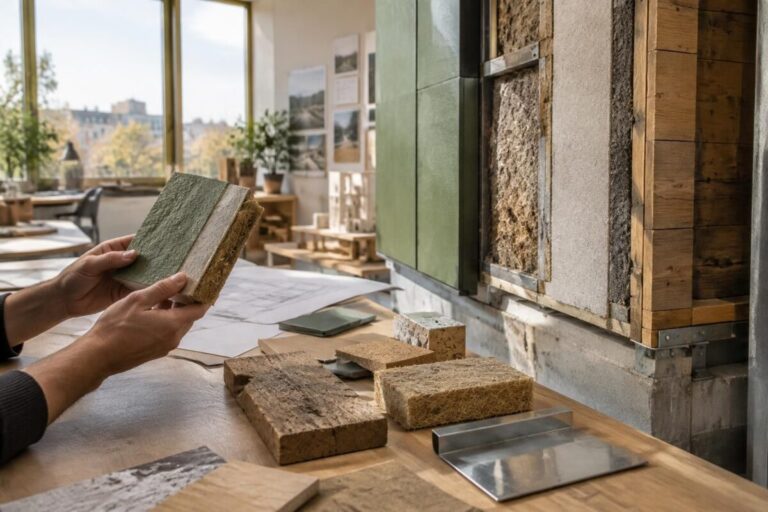

Sustainable materials: the right material simplifies the entire construction site
Hello, this is Quentin. To simplify your project, choose a durable material that suits the substrate, the climate, and the installation skills available. This good choice minimizes cuts, rework, and waste, while contributing to the comfort of the home. In eco-construction, performance depends as much on how it is implemented as on the material itself.
Do It Now
- Check the substrate and its condition before selecting an insulation, a coating or a plaster.
- Compare the performances useful to the project: insulation, moisture resistance, maintenance and durability.
- Ask for the available dimensions to plan cuts and limit waste.
- Confirm the installation method with the craftsman, especially if the product requires special tools or expertise.
- Anticipate storage and delivery to protect the materials and avoid urgent orders.
Before deciding, you can consult this comparison of durable materials and identify the options to avoid in renovation. These references help you make a choice that aligns with the building, not just with a label or a displayed price.
The choice of materials can lighten the project
An ecological material is not automatically the easiest to install. It must be compatible with the structure, the local climate, and the other layers of the building. Otherwise, a good intention can lead to costly adaptations or rework.
Imagine Lina, who is renovating a small stone house. She is considering a breathable insulation, but first checks the humidity of the walls and asks her craftsman which complete system would be suitable. This check helps her avoid ordering a product that would not work with the existing substrate.
If the material is compatible, installation becomes smoother
Formats that are easy to handle and locally available can reduce lead times and waste. Good ease of implementation also matters: a product poorly suited to the team’s skills risks slowing the project, even if it shows good performance on paper.
Conversely, if the building requires a particular solution, it is better to prioritize technical compatibility rather than a product simply reputed easy to install. Responsible construction starts with a choice adapted to real use.
Compare ecological materials according to the project
The table below provides general guidelines, not universal prescription. Performance varies depending on the product, its composition, its thickness and its implementation: always check the technical data sheets and the manufacturer’s instructions.
| Material or solution | Possible advantage | Aspect to check |
|---|---|---|
| Wood fiber | Can contribute to thermal comfort and summer thermal lag | Compatibility with humidity, the substrate and the installation system |
| Cellulose insulation | Adaptable to different configurations depending on its form | Installation technique, required density and moisture protection |
| Lime plaster | Suitable for certain old walls and breathable finishes | Nature of the substrate, preparation and drying time |
| Certified wood | May be suitable for a structure or for lightweight cladding | Origin, treatment, exposure to weather and maintenance |
Don’t just compare the cost at purchase. Durability, maintenance, availability and the amount of waste also influence the overall cost and waste reduction. A material that is slightly more expensive can simplify the project if it avoids complex cuts or early replacements.
Three steps to prepare a simpler project
- Describe the need. Note the function of the material, the condition of the substrate, the humidity constraints and the expected performance, especially in terms of energy performance.
- Have the solution validated. Compare two or three options with the craftsman, the technical data sheets and the available dimensions. Also check the timelines and storage conditions.
- Plan the installation and the waste. Plan the order of works, the quantity to order and the reuse or sorting of surplus before the project begins.
This method turns the choice of materials into a practical decision: each product meets a precise need and finds its place in a coherent whole.
Questions to ask before buying
Is a durable material necessarily more expensive?
Not always. Compare the purchase cost, installation, maintenance and lifespan. A more expensive solution at purchase can reduce rework or replacements, but this depends on the project.
How to avoid compatibility errors?
Examine the substrate and its constraints, then have the complete system confirmed by a professional. The materials must work together, especially with moisture and the building’s movements.
How to reduce waste during installation?
Take measurements before ordering, check the available formats and plan the cuts. Also plan for sorting or reuse of scraps when possible.
Which criterion to look at first?
Start with the use and compatibility with the building. Then compare the performances, the ease of implementation, the lifespan and maintenance needs.
I hope these tips have been helpful. See you soon! — Quentin