
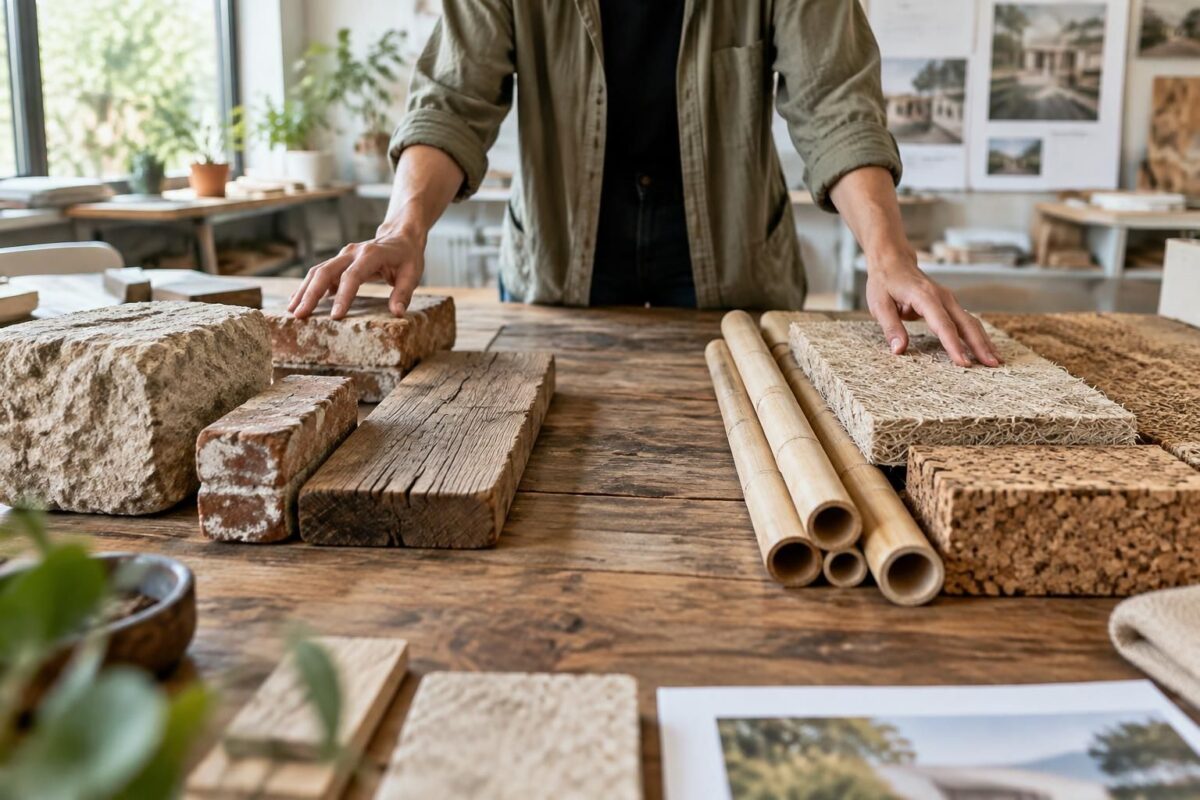
Sustainable materials: local or renewable, which to sacrifice
Hello, it’s Quentin. To weigh up between local materials and renewable materials, compare their impact across their entire life cycle, then favor the well-suited and properly installed solution. A locally sourced material isn’t always the least polluting, and a natural material isn’t automatically durable. The right choice depends on the construction site, the climate, and verifiable data.
Act now: five choices for durable materials
- Check the home assessment and identify the priority item: roof, walls, floor, or windows.
- Request the product’s EPD (FDES) and compare its impact over the same duration and the same unit of use.
- Prefer local materials when their performance and service life meet the need.
- Choose renewable or recycled materials if their provenance, installation and end of life are documented.
- Plan for detachable fixings to facilitate reuse and the circular economy.
To frame your choice, consult this guide on local or high-performance materials, then the advice for starting a project with durable materials.
Local or renewable: which ecological compromise should you choose?
A local material often reduces transport distances and can support local supply chains. But its origin is not enough: a stone extracted near you may require a lot of energy to process, while a bio-based insulation from farther away may have a better overall balance.
The useful comparison focuses on the product’s carbon footprint, its manufacture, its transport, its maintenance, and its end of life. The FDES, accessible in the INIES database, helps assess these impacts on common bases.
Certified wood and cellulose or wood-fiber insulation are common options. Raw earth can be suitable for partitions and plasters, while low-carbon concrete remains relevant for certain structural elements. It is not about banning a family of materials, but about avoiding the performance sacrifice where it would harm comfort or safety.
Compare solutions according to their use
| Material | Common use | Strength to evaluate | Note of caution |
|---|---|---|---|
| Certified wood | Framing, carpentry, cladding | Renewable resource and carbon storage | Certification, species, and moisture protection |
| Cellulose insulation | Attics, blown-in walls | Recycled paper and installation often competitive | Density, settling and installation quality |
| Wood fiber | Walls, roof, floors | Summer comfort and insulation | Cost and compatibility with the construction system |
| Raw earth | Partitions, plasters | Thermal inertia and humidity regulation | Water protection and installation know-how |
| Low-carbon concrete | Foundations, slabs, structure | Possible reduction of clinker | Formulation, setting time and local availability |
Performance depends on the products and their installation. For insulation materials, thickness and air tightness often matter more than a small variance in declared conductivity.
Evaluate material costs beyond just the quote
The cost of materials can be higher for certain bio-based panels or specialized products. Other options, such as blown cellulose, can approach the price of traditional insulations, depending on the model, region, and installation.
Compare the overall cost of the package, not just the product per square meter. A good insulation can reduce heating needs and improve summer comfort; a durable, removable and well-maintained material can also avoid premature replacement.
An anecdote nicely sums up the issue: during a renovation, a family wanted to replace a parquet still in good condition with new flooring marketed as ecological. After verification, keeping it and insulating the floor from below proved simpler and avoided waste.
“The most ecological material is often the one you don’t need to replace.” This rule gives real weight to reuse and to biodegradability, but the latter does not replace checking durability, treatments, and the end-of-life scenario.
Two scenarios to guide your decision
If a renewable resource is available near the site and has an appropriate FDES, favor it to limit transport and impact. If a local material does not meet humidity or strength constraints, choose a more high-performing solution and justify this compromise with technical data.
Choosing and installing materials in three steps
- Step 1: determine the needs from the diagnosis and set a concrete priority: reduce heat losses, improve summer comfort or purify the indoor air.
- Step 2: request the exact product references, their FDES, their certifications and installation instructions. Compare solutions for the same use, and do not rely solely on the words “natural” or “green.”
- Step 3: validate the implementation with the company and keep the technical data sheets. Plan for disassembly, sorting and reuse from the choice of assemblies.
Installation is part of the result: a poorly jointed insulation or a wall poorly protected from moisture loses part of its effectiveness. Renovation subsidies can ease some works, subject to the criteria and rules in force; check the conditions before signing the quote.
Useful ecological compromises, without all-or-nothing choices
There is no perfect material for every part of a house. Concrete may remain suitable for foundations, while certified wood suits a structure and raw earth improves certain partitions. A synthetic insulation may also be justified in a location with particular constraints, if no other option offers the required reliability.
The right arbitration avoids two traps: paying more without real gains, or choosing a “green” product that won’t hold up under site conditions. Ecological compromises become relevant when they are based on data, a controlled installation, and a coherent service life.
Useful questions before buying durable materials
Is a local material always more ecological?
No. Transportation matters, but so do extraction, manufacturing, lifespan, and end of life. Compare the FDES of products suited to the same use.
Do renewable materials always cost more?
No. The price varies depending on the product, the site and the installation. Cellulose insulation can be competitive, while some wood-fiber boards or cork cost more.
How to verify a material’s impacts?
Request its FDES and check it in the INIES database. Also verify the useful certifications, emissions in indoor air, and the conditions of installation.
Should you replace a material still in good condition?
Not necessarily. Keeping it or reusing it often avoids new manufacturing and waste production. Start by assessing its condition and compatibility with the project.
Thank you for your interest. Best regards, Quentin

