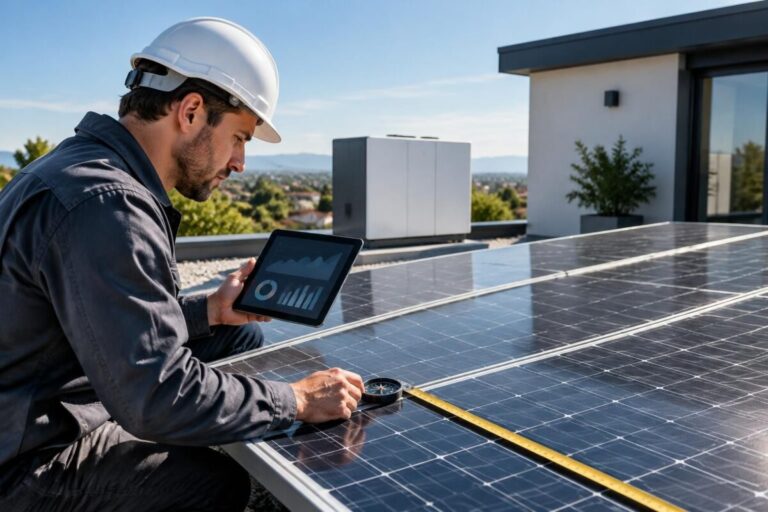
Passive House: How to Avoid Fragile Energy Autonomy
Hello, this is Quentin. A passive house avoids fragile autonomy by first reducing its needs, then sizing the equipment according to actual uses and the seasons. Trying to produce and store everything without evaluating consumption can be costly and does not guarantee energy on difficult days.
Energy efficiency, a high-performance envelope, and a realistic contingency plan form a sturdier foundation than a promise of total independence.
Actions to take now to secure energy autonomy
- Record your energy consumption over several weeks and identify devices that run continuously.
- Prioritize thermal insulation and airtightness before adding panels or a battery.
- List the essential equipment to power in case of a blackout: refrigerator, lighting, the grid, or a pump.
- Check production by season, especially in winter, when days are short and needs are higher.
- Plan the maintenance of equipment: filters, ventilation, inverter, battery and electrical protections.
A high-performance house is not necessarily off-grid: staying connected can serve as a safety net when solar production dips. To lay the right foundations, see the questions to ask before aiming for the autonomy of a building and the solutions to better resist power outages.
Why a passive house can keep a fragile autonomy
A passive house greatly reduces its heating needs thanks to an efficient envelope, climate-appropriate design and controlled ventilation. But low consumption does not guarantee supply : an inverter failure, several days of outages or a poorly sized battery can limit the services available.
The risk often arises from a mismatch between needs and planned resources. A solar installation can produce a lot over the year, while delivering too little at the moment the dwelling needs it most.
The all-electric trap without a backup plan
Two-flow ventilation with heat recovery contributes to comfort and recovers part of the heat from the extracted air. It does depend on electricity. Therefore you need to know what happens if it stops, how long essential devices can operate, and how to maintain healthy indoor air.
An auxiliary heater can also be useful in certain configurations, but it must be chosen with regard to safety, air quality and local regulations. It does not replace either good design or a continuous envelope.
Reduce needs before adding energy storage
Energy storage can shift the use of solar electricity to the evening, but it does not create energy. A battery cannot compensate for several days of low production if its capacity, power or planned reserves do not match the needs.
Start by separating essential consumption from flexible uses. The water heater, the washing machine or charging a vehicle can sometimes be scheduled during production hours, while security lighting or the refrigerator require a more regular power supply.
| Need | Useful action | Caution |
|---|---|---|
| Heat | Improve thermal insulation and reduce air losses | Also evaluate summer comfort and solar protections |
| Daily electricity | Shift flexible uses to production periods | Production varies with weather and season |
| Backup in case of outage | Define priority devices and their duration of power | Check the output power, not just battery capacity |
| Water | Reduce needs and plan appropriate water management | Pumps and treatments may depend on the electrical network |
A simple example of thoughtful sizing
In a household that wants to keep the lighting, the refrigerator, and the internet box running in case of a blackout, the first instinct is to measure these usages, rather than trying to power the whole house. An electrician or an engineering consultancy can then verify the required power, the targeted autonomy, and the compatibility of the equipment.
This approach avoids paying for a large battery that remains underutilized or does not meet the starting power of a device. The right system is the one that covers the priority needs under clearly defined conditions.
Energy resilience that accounts for water and maintenance
The autonomy of a dwelling is not limited to electricity. Water management also matters: a house equipped with a pump, a recovery system or autonomous treatment must plan their operation in case of outage and the steps necessary to preserve water quality.
The maintenance of equipment is just as crucial. Clogged ventilation filters, a poorly monitored battery or a backup device never tested can weaken an installation that is otherwise well designed.
Plan a simple calendar: regular visual checks, maintenance according to the manufacturers’ recommendations, and periodic testing of the backup mode. Energy resilience depends as much on these habits as on the installed technology.
Three steps to build robust autonomy
- Measure your needs. Track consumption and distinguish essential loads from uses you can shift or reduce.
- Design a coherent system. Have insulation, solar production, potential storage, and backup solutions evaluated according to the local climate.
- Test and maintain. Check how the home behaves in case of outage and keep the equipment according to the technical instructions.
A passive house becomes more resilient when each piece of equipment serves a precise need and failure scenarios are anticipated. The aim is not to make everything autonomous at any cost, but to ensure essential comfort with controlled consumption.
Frequently asked questions about energy autonomy in a passive house
Is a passive house necessarily energy autonomous?
No. The passive standard mainly aims to reduce the building’s energy needs. Autonomy also depends on production, possible storage, uses, and backup solutions.
Is a battery indispensable in a passive house?
Not always. It can increase on-site use of solar electricity and provide a backup if the installation is designed for it. Its usefulness depends on consumption, the price of electricity, seasonal production, and the budget.
How to avoid electricity shortages in winter?
First reduce needs, check winter production and define the priority devices. A connection to the grid or an appropriate backup solution can complement the photovoltaic installation.
What maintenance should be planned for a passive house?
Maintenance concerns especially the filters and the operation of the double-flow ventilation, as well as electrical equipment, batteries and backup devices. Follow the manufacturers’ recommendations and have installations checked by qualified professionals when necessary.
Thanks for reading! Feel free to share your observations in the comments. — Quentin