Green energy: this bad calculation creates a shaky house
Hello, this is Quentin.
To avoid an unstable house, evaluate the impact of materials and equipment as well as the expected energy savings, then plan the work in the right order.
A calculation based only on heating bills can mask a large part of the building’s emissions. Scope 3 — materials, transport, construction, and end-of-life — therefore deserves special attention.
A poor energy calculation does not directly undermine the foundations, but it can lead to a renovation that is poorly sequenced, costly and inefficient.
Things to do without delay
- Evaluate the whole building : materials, equipment, transport, and end of life.
- Use verifiable data, such as EPDs, rather than estimates based solely on product price.
- Check the condition of the building fabric before choosing thermal insulation or installing solar panels.
- Plan a coherent energy renovation, instead of chaining isolated works.
- Compare funding and verify their conditions with the relevant authorities before starting the project.
To prepare the steps, consult this guide on the right order of green-energy-related works and these tips on the common mistakes with solar panels.
The trap of an incomplete carbon calculation in a building
The most common risk is measuring only the energy consumed during occupancy. Yet materials, their transport, their replacement, and their end-of-life processing also weigh in the carbon balance.
These indirect emissions are generally categorized as Scope 3. Their share varies depending on the building, its lifetime, and the calculation method: some inventories treat them as a major fraction of the total footprint, while no single percentage fits all projects.
An approximation can distort comparisons between solutions. An insulation measure or solar panels should not be ruled out: one must compare their manufacturing impact to the expected savings and to their service life.
A renovation can be eco-friendly without being well designed
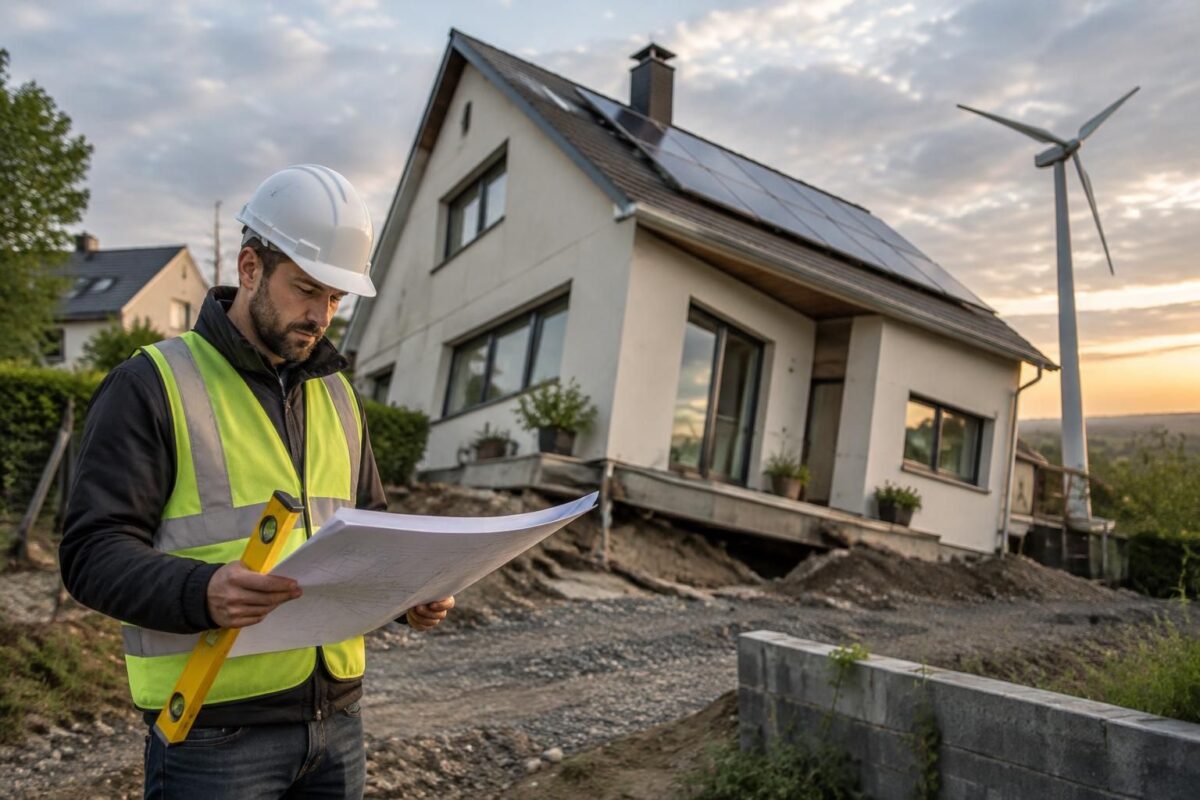
Imagine an old house where the owner replaces the heating, then discovers that the attic remains poorly insulated and that the ventilation is no longer suitable. The new equipment may then be oversized, while humidity or thermal comfort become real issues.
This is where the structural balance and energy performance come together: the state of the building, insulation, ventilation and the sizing of the equipment must be examined together. A design error is easier to fix on paper than on site.
The carbon calculation must also look at the supply chain. An article on the financing of minerals needed for green energies reminds us that the impact of a technology does not stop at its installation in your home.
| Item to examine | What to measure | Useful data |
|---|---|---|
| Materials and equipment | Manufacture, transport, replacement, and end of life | EPDs and circularity passports available |
| Energy during operation | Actual energy consumptions and building uses | EPCs and consumption readings |
| Renovation works | Combined effects of interventions and possible savings | Audit and simulations tailored to the building |
The values obtained depend on the products, uses and assumptions. To compare two options, keep the same scope of calculation and check the data behind each result.
Three steps for a more coherent home
- Take stock. List the materials, the equipment, their condition and the dwelling’s energy consumption. For an existing building, a professional can help identify constraints that old plans do not show.
- Compare with reliable data. Rely on EPDs when available and on a recognized method, such as EN 15978 for the environmental assessment of buildings. The results should specify their assumptions.
- Simulate the complete scenario. Compare several combinations of work: insulation, ventilation, heating and solar panels. Adjust the sizing of equipment after assessing actual needs.
For an old building, a holistic renovation can avoid conflicting interventions, but it must respect the constraints of the building. In a new build, integrating the energy calculation from design helps avoid oversized equipment and poorly suited materials.
Grants and loans can facilitate a project, but their name does not guarantee their availability or relevance. Check current conditions and request a financing plan that accounts for the full cost of the works.
Questions to clarify before starting the works
Why does the scope 3 matter in the carbon balance of a house?
It includes emissions related to materials, their transport, their replacement, and their end of life. Ignoring it can skew comparisons between several renovation options.
Does a bad carbon estimate make the house unstable?
Not directly. An unstable house mainly signals an incoherent strategy: poorly sequenced works, ill-suited equipment or overestimated savings. Structural problems, however, require a specific diagnosis.
Why prioritize EPDs?
They provide environmental information related to a construction product. They enable a more documented comparison than simple estimates, provided you verify that the products and the boundaries are comparable.
Should solar panels be installed before insulating?
Not automatically. First evaluate the building’s condition, its needs, its roof, and the ventilation. The proper order depends on the dwelling and should be defined from a diagnosis.
I hope these tips have been helpful. See you soon! — Quentin