
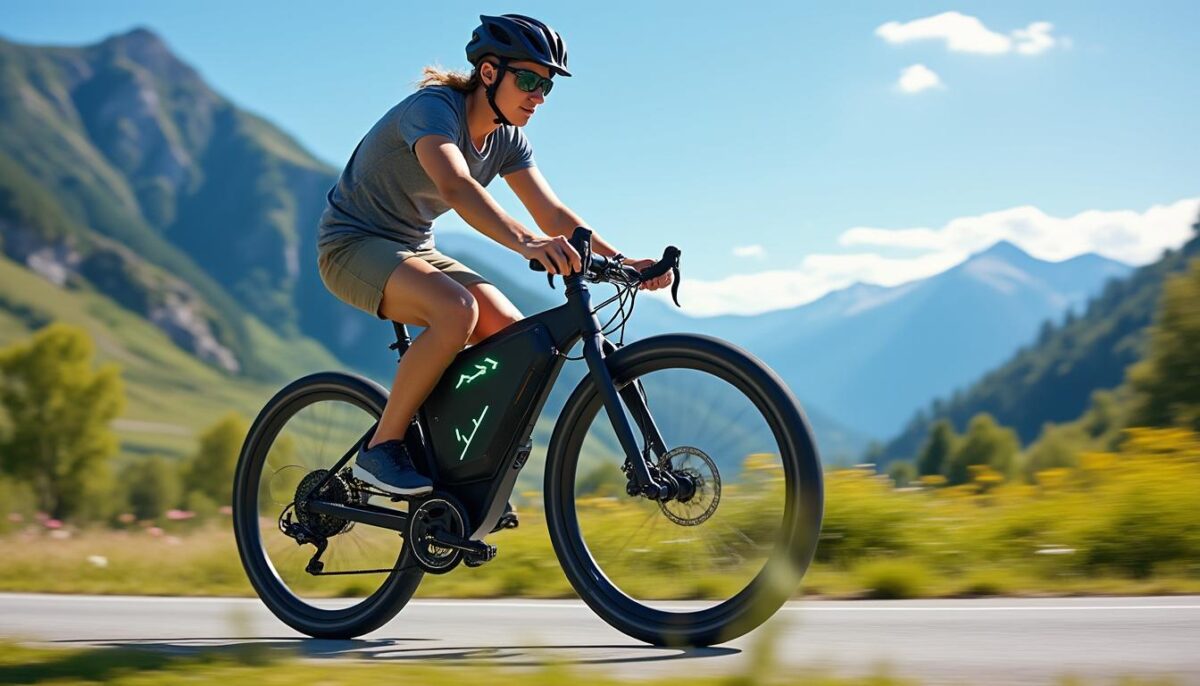
Electric bicycle generator: how it works
Hi, this is Quentin. A pedal-powered electricity generator allows you to transform your pedaling into usable current to power a lamp, recharge a small battery, or understand energy production concretely. The principle is simple: the wheel drives an electric generator, then a regulator stabilizes the energy produced. But before building a pedal-powered electricity generator at home, you need to know the real limits, the necessary components, and possible uses without imagining full autonomy.
How does a pedal-powered electricity generator work?
In essence, the pedal-powered generator converts the mechanical energy from your pedaling into useful electrical energy. The rotation of the wheel is captured by a generator, often an inverted electric motor that produces direct current. Then, with a regulator, this energy is stabilized to be used immediately or stored in a battery. Whether you choose a friction system or direct transmission via the chain, the logic remains the same: your muscles become the energy source. When energy production meets daily mobility, it becomes natural to also be interested in solutions around cleaner vehicles.
- Bicycle: stationary or regular bike fixed on a stand.
- Generator: converts the force into electricity adapted to the rotation speed and the targeted power.
- Regulator/Converter: adjusts the voltage to prevent surges.
- Battery: stores energy for later use (lead-acid or lithium).
The key point: watts (W) indicate instantaneous power, watt-hours (Wh) an amount of energy. A system delivering 50 W of electrical power for 30 minutes provides 25 Wh, or 0.025 kWh, before any storage and recharge losses.
Pedal-powered generator: price and criteria to check before buying
The price varies depending on whether you buy a generator alone, a kit to adapt to your bike, or a complete device with storage. Compare equivalent sets: stand, mechanical protections, regulation, usable outputs and any battery. An advertised maximum power does not guarantee the electrical power you will sustain during a session.
- Useful power: request a measured output value, at a sustainable effort, and not just a peak.
- Compatibility: check voltages, connectors and supported devices.
- Total cost: include accessories, storage, delivery and maintenance parts.
Here are examples of calculations at constant electrical power, with no performance guarantees for a cyclist or a model:
| Measured electric power | Duration | Energy produced | Practical takeaway |
|---|---|---|---|
| 25 W | 30 min | 12.5 Wh | Small uses, losses to deduct |
| 50 W | 1 h | 50 Wh | 0.05 kWh, before storage |
| 100 W | 30 min | 50 Wh | Same energy, higher effort |
Build and use your own pedal-powered electricity generator
An unused bicycle can serve as the basis for an educational project, provided that the frame, drive system and electrical part are designed and protected correctly. The generator feeds a regulator compatible with the load: you do not directly connect a battery or a phone to a variable output. A simple home trainer does not necessarily produce recoverable electricity.
- An old bicycle or an exercise bike.
- An electric motor (often 24V DC, but depending on usage).
- A stable mounting system to keep the bike upright.
- A voltage converter and charge regulator.
- A compatible battery and charger, with protections as provided by the manufacturer; no technology is risk-free.
- Protected low-voltage outputs for the intended uses; do not connect an artisanal setup to a home outlet or to the grid.
To estimate usage, calculate energy ÷ device power. With 50 Wh actually available, a 5 W lamp could run for 10 hours in an ideal calculation; conversions and storage reduce this duration. A phone’s capacity is compared in Wh, not directly in mAh without knowing the voltage. The Éduscol educational project on charging by pedaling illustrates precisely these losses and the role of regulation.
Challenges and tips to maximize efficiency
Electric power depends on the effort, duration and the efficiency of the entire chain. Start with a short and comfortable session: the energy meter should not push you to overdo it. To build a habit suited to your level, the advice on physical activity and progression can complement the technical part of the project.
- Challenge: production limit – adapt devices that consume little (LED lighting, USB charging).
- Challenge: intermittency – plan for appropriate storage, as the reserve remains limited.
- Challenge: charger tuning – use a regulator and protections that are compatible, validated before use.
On the economics side, keep the proportions: 50 Wh equals 0.05 kWh. With a fictional rate of 0.20 €/kWh, this session would be worth 0.01 € of electricity. This calculation is not a current rate: replace it with the one on your bill. The value of the pedal-powered bicycle is mainly educational and entertaining, rather than quickly paying back its equipment.
FAQ quick on using a pedal-powered electricity generator
What power can one expect to produce with a pedal-powered generator?
There is no single guaranteed power. Measure the electrical watts output and the sustainable duration: 50 W for one hour yields 50 Wh, before any additional losses. Do not confuse muscular power with available electrical power.
Can you power an entire house with a pedal-powered bicycle?
An individual bicycle is not a realistic solution for fully powering a home. It is mainly suitable for small devices and for awareness: producing 1 kWh at 50 W would require 20 hours of pedaling, before additional losses.
Is a special bike needed to generate electricity?
Not necessarily. A regular bicycle fixed to a stable support may suffice. Stationary bikes or home trainers make setup easier.
What are the risks associated with using a pedal-powered bicycle?
The main risks are related to voltage surges if the system is not regulated properly, and to the mechanical safety of the installation. Always use appropriate components and protections.
Is this solution economically viable?
If you factor in the price of equipment and your time, it is more of an ecological and educational undertaking than an economic one. But for some isolated environments, it is an interesting alternative.
Thanks for your discovery. Best regards, Quentin