
Sustainable materials: the comparison helps you avoid a bad choice
Hi, this is Quentin.
To avoid making the wrong choice, compare materials according to their environmental impact, their lifespan, their maintenance, and their total cost, not just their purchase price. The right material also depends on the room, the local climate and how the building will be used. A few simple checks help distinguish a truly durable solution from an option that is only appealing on the label.
Do it now
- Define the use : insulation, structure, finish or a damp room.
- Ask for the technical data sheet and, if available, the product’s EPD (Environmental Product Declaration).
- Compare performances for the same function and equivalent service life.
- Check origin, emissions and reparability of the material.
- Add to the budget the installation, maintenance and end-of-life costs.
A useful material comparison puts their real performance and installation constraints side by side. To extend this check, also consult this guide on the choice of materials built to last and these guidelines for avoiding common mistakes on site.
Comparison of durable materials by use
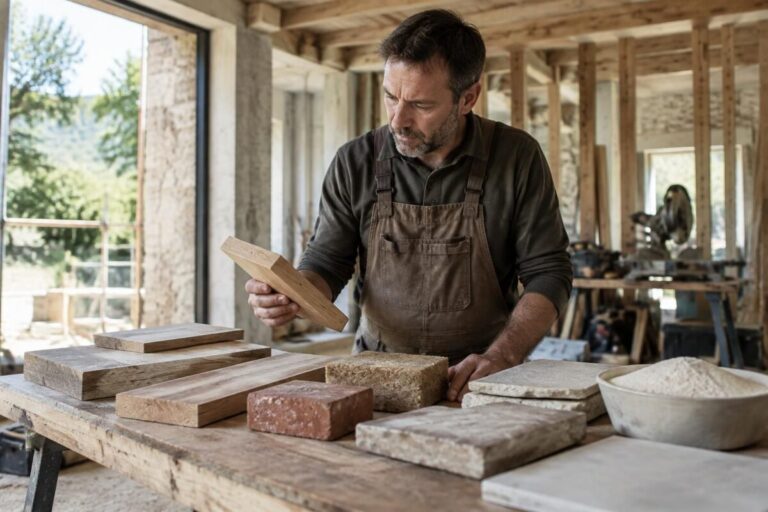
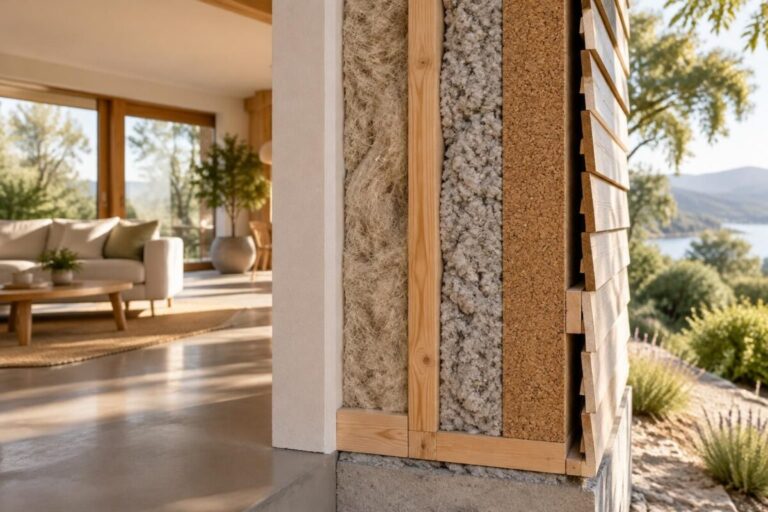
Certified wood, especially FSC or PEFC certified, is suitable for framing and finishing, provided you verify its origin and treatments. Hemp and recycled cellulose are insulation options, while raw earth can help regulate interior humidity when protected from water.
| Material | Main advantage | Point to check |
|---|---|---|
| Certified wood | Renewable resource, suitable for framing and cladding | Origin, certification and treatments |
| Hemp | Insulation and moisture regulation | Compatibility with the wall and installation conditions |
| Cellulose insulation | Thermal and acoustic insulation from recycled paper | Careful installation to limit settling |
| Raw earth | Low processing and humidity regulation | Protection from water and weather |
| Recycled materials | Reuse of resources and waste reduction | Technical compatibility with the project |
This table does not designate a universal winner: the choice of materials depends on the function expected. A cellulose insulation that is poorly installed may lose efficiency, while an earth plaster in a zone exposed to water spray will require appropriate protection.
How to measure environmental impact without trusting appearances
Eco-design considers the entire product life cycle: extraction, manufacturing, transport, installation, maintenance and end of life. A life cycle assessment and an EPD (Environmental Product Declaration) facilitate comparison, provided you examine products with similar function and service life.
Proximity can reduce transportation, but it does not by itself guarantee a low carbon footprint. Also check traceability, volatile organic compound (VOC) emissions, humidity resistance and possibilities for repair or reuse.
Don’t confuse a label with suitable performance
Certifications provide benchmarks, but they do not replace reading the technical data sheets. For a bedroom, emissions and indoor air quality are essential; for a bathroom, humidity resistance and layer compatibility matter more.
Eco-friendly materials must also work well with one another. A wall designed to let water vapor migrate can be weakened by an unsuitable finish: it is better to check the whole system than to select each product separately.
A concrete example for weighing price against durability
To renovate the attic of a house, a family compares a synthetic insulation and recycled cellulose. They look at the installed price, advertised performance, installation conditions and anticipated maintenance, then ask the tradespeople how each solution fits with the existing roof structure.
Cellulose can be relevant if installation is well controlled and the substrate is compatible. But if access, moisture or the attic configuration complicates the installation, another solution may offer a better actual result. The durability of materials is judged in the building, not only on the product sheet.
Three steps to secure the material choice
- Set priorities. Note uses, sensitive zones, desired comfort and available budget.
- Compare for equivalent service. Compare performance, carbon footprint, installation cost, maintenance, lifespan and end of life.
- Inspect before and during the work. Check delivered references, storage conditions and the conformity of the installation with the recommendations.
This method makes responsible consumption concrete: it avoids purchases guided by a single label and limits losses due to incompatibilities or ordering mistakes. A well-chosen material should meet the need, last and remain repairable.
Useful questions before buying durable materials
What is the best durable material for a house?
There is no ideal material for all uses. The right choice depends on the function, the climate, the compatibility with the building, the installation and the overall cost.
How to compare two construction materials?
Compare them for the same function and a comparable service life. Examine performance, the EPD/FDES if available, origin, emissions, maintenance and possibilities for reuse or recycling.
Are natural materials always more ecological?
Not automatically. Their origin, their transformation, their transport, their processing and their durability also count. An improper installation can reduce their benefits.
Why consider the maintenance cost?
The purchase price represents only part of the expense. Maintenance, repairs and the lifespan can modify the total cost over several decades.
Thank you for reading! Feel free to share your observations in the comments. — Quentin